Whats Koreas Obsession With Blond Hair and Blue Eyes
Flowerboys and the entreatment of 'soft masculinity' in South Korea
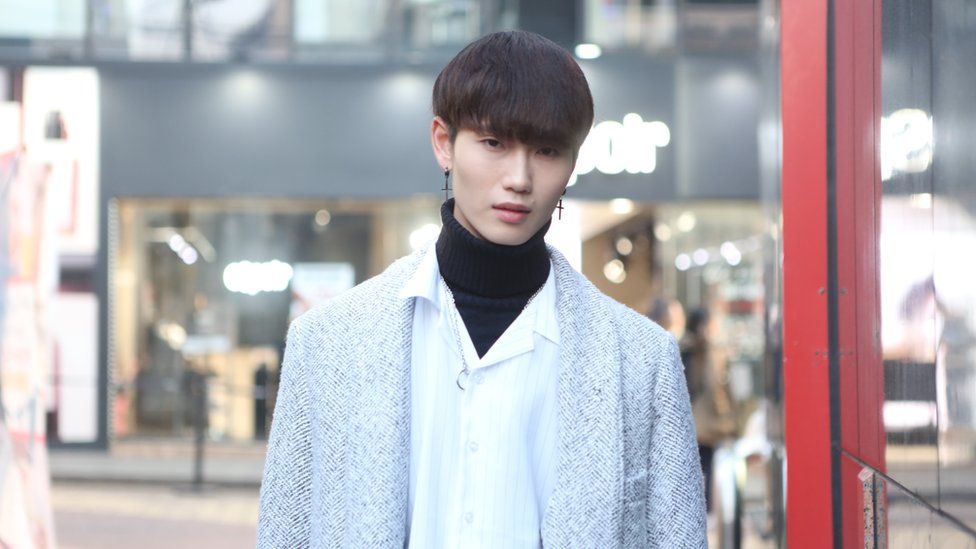
A man wearing brand-upwardly on the street may arm-twist unwelcome glares, questions about his masculinity and even his sexuality. Simply in Republic of korea, ideas nigh how to expect skilful as a man are irresolute attitudes and influencing the globe, every bit the BBC's Saira Asher reports.
When the BBC posted a video about the make-upwardly routine of a 16-twelvemonth-sometime YouTuber in Seoul on Facebook, the reactions ranged from intrigued to downright vitriolic.
Some causeless this meant he was gay, while others admonished him for his pick saying "real men don't wear make-up". There were, of course, those that argued for his freedom to alive life however he pleased and against the "fragile masculinities" on show.
But Kim Seung-hwan is used to it. He says he's been called gay by some Koreans online for every bit long every bit he's been doing brand-upwards tutorials.
A YouTube vlogger talks virtually why he wears make-up
When asked virtually whether he thought he looked feminine later on he put on brand-up, he was dislocated by the question as if he had never even thought nigh information technology.
"No I don't. I do not think about this being a girly look," he says. "It's about looking skilful."
Within a male beauty salon
For those uncomfortable with men who clothing make-up, the scene at a loftier-end salon for men in Seoul's Gangnam district would accept been quite something. Only information technology points to an important shift in cultural expectations.
Senior make-up creative person Han Hyun-jae expertly applies foundation, eyeliner and lipstick on a human. He chooses from an array of products and brands that will be familiar to most women, and goes in for the final touches of what he calls the Thou-popular (brusque for Korean pop) look . Information technology'due south a scene that repeats itself day later mean solar day.
Packs of confident young men saunter into the salon and then exit with perfect skin and hair. Many of them are singers or actors on their mode to promotional events.
"I use toner and lotion, then CC foam (colour correction cream). I will utilize facial pack later facial exfoliating."
One homo is there for his wedding make-upwardly, a mutual practice for men in Republic of korea. He chooses to go red lips for his special day.
"We make their complexion cleaner, eyebrows darker, contour their faces and describe out their masculinity in a style they can't do themselves," says Mr Han. He says men come in wanting to look like their favourite Grand-pop idols.
In the last few years, K-pop bands and Korean dramas have become the major influence on young people in the land and concluding twelvemonth Thousand-popular broke into the mainstream U.s.a. and Uk music scenes.
"I recall Korea is a trailblazer in men'southward beauty culture, definitely in Asia at the moment, if not the earth," says Joanna Elfving-Hwang from the Academy of Western Australia, who has done extensive research on beauty and image in S Korea.
"The mode they (K-pop stars) play with masculinity, what it means to exist a beautiful man in a heterosexual or non-heterosexual way, it opens up possibilities for men on the street and somewhen makes it more acceptable."
This doesn't mean every human being in Seoul walks around with a full face of make-upwards.
Just in young and fashionable neighbourhoods like Myeong-dong it'south mutual to see men walking around with foundation or BB cream (blotch lotion) - a moisturiser and lite foundation hybrid.
More importantly it has allowed for a much looser interpretation of what's acceptable for men when information technology comes to dazzler.
And some immature Korean men are unapologetic nigh the bulldoze to enhance their expect.
From tough guy to pretty boy
That wasn't always the case. In the 1980s and 90s the salaryman was the prevailing male aesthetic. Suits, luxury watches and a traditional strong male await were the norm. Korea has mandatory national service and that moulded and defined what men thought would look appealing.
"In the 80s and 90s, men in Korean pop content were largely portrayed every bit tough guys in gangster and detective films, and rebellious immature men in some Tv set dramas," says Dominicus Jung, the writer of Korean Masculinities and Transcultural Consumption.
But all that changed in the mid-1990s when music group Seo Taeji and The Boys came onto the scene, says Prof Elfving-Hwang. They used rap, rock and techno influences and incorporated English language into their music.
They kicking-started fan culture which has now get a major force in the music industry, she says.
So followed the big entertainment companies churning out One thousand-pop daughter bands and boy bands, and their influence has been like nothing before information technology.
In Due south Korea, men oftentimes wear brand-up for their wedding day
"Compared to the 80s and 90s, now there are a lot more soft masculinities - pretty male child images and gentle male images - represented in media, and consumers welcome and widely consume them," says Dr Sun Jung.
They came to exist known as Khonminam - combining the words for flower and a beautiful man. She says it takes inspiration from similar concepts in Japan of bishonen or beautiful boys and Shojo manga - girls comics.
"I think the miracle should rather exist explained through the notion of hybrid or versatile masculinity - soft yet manly at the same time - which is dissimilar from effeminised," says Dr Jung.
She cites Song Joong-ki, the star of hugely popular Korean drama "Descendants of the Sun" every bit the embodiment of this. He may be a khonminam in his look, but equally a special forces captain in the war machine he is too a tough guy.
Paradigm source, Francois Durand
Song Joong-ki is seen as the typical Korean male appeal
Descendants of the Sun and other Korean dramas have helped spread the South Korean look effectually Asia and at present the world. And that ways the means to accomplish that wait are in demand.
Male idols are plastered on billboards in Seoul hawking products like confront masks and moisturisers. Companies are actively hiring men to sell women make-up products.
Their fandom in places similar China, Thailand and Singapore is not to be dismissed either. Huge crowds bear witness upwardly to their performances and product launches.
"Men in China and South East Asia tend to think that Korean men are the typical dazzler," says Lee Gung-min, a consultant to South Korean beauty companies.
"That is having a huge impact on male consumers in Asia."
Korean dazzler boom
Across Asia, make Korea is starting to sell well in the Us and Europe.
Walmart and Sephora now have Yard-beauty (Korean beauty) brands on their shelves and beauty bloggers are spouting the virtues of the 10-step K-dazzler routine for glowing skin. American and European make-upwardly enthusiasts are fast becoming acquainted with brands that were previously only popular in Asia similar TonyMoly, Innisfree and Etude Business firm.
Most interestingly, established dazzler brands are making their own versions of products that originated in South korea - like Clinique, Lancome and 50'oreal introducing absorber compacts.
Korean dazzler brands take surged in popularity in many Western markets
The drive for the perfect face has undoubtedly too contributed to a well reported rise in corrective surgeries in South Korea to reach the desired jawline or nose. But it also stems from a deeply ingrained preoccupation with how you nowadays yourself to others.
That's a common sentiment across Seoul. People here really care about how they look and how they come up off to the world - both men and women.
You can't walk a few steps without coming across a cosmetics or skincare store with a salesperson exterior trying to lure you in with a free confront mask, and companies are definitely capitalising on that self-care civilisation to sell products.
But men are now every bit much at the receiving cease of that drive - or maybe pressure level - for self enhancement that women have felt for generations.
Source: https://www.bbc.com/news/world-asia-42499809
0 Response to "Whats Koreas Obsession With Blond Hair and Blue Eyes"
Post a Comment